Getting started with Azure
In this document you will find the test procedure using a powerful cloud computing service Azure. Follow the steps below to configure your local computer and run LISA test against Linux VM on Azure.
Sign in to Azure
Make sure either Azure CLI or Azure PowerShell has been installed on your local computer. Then log in to your Azure subscription to authenticate your current session. LISA also supports other Azure authentications, for more information, please refer to :doc: runbook reference <runbook>.
Here, let’s choose
Azure CLIfor the setup. You should see a page pop up and all your Azure subscriptions shown in console after running the following command.az loginGet the subscription ID
A subscription ID is a unique identifier for your server. LISA needs to know the Azure subscription ID for your testing. Run below command to retrieve subscription information.
az account show --subscription "<your subscription Name>"
You should get something in the following format. For now you only need the
<subscription id>for future use.{ "environmentName": "AzureCloud", "homeTenantId": "<tenant id>", "id": "<subscription id>", "isDefault": true, "managedByTenants": [], "name": "<subscription name>", "state": "Enabled", "tenantId": "<tenant id>", "user": { "name": "<user account>", "type": "user" } }
Note although the example subscription named “AzureCloud” has the attribute
isDefaultas true, it’s not necessary to do so as long as you provide the correct<subscription id>.Run LISA
Use above
<subscription id>to run LISA with the default runbook. It might take several minutes to complete.lisa -r ./microsoft/runbook/azure.yml -v subscription_id:<subscription id>
If you use the docker on Linux, use below command to run LISA.
-v ~/.azure:/root/.azureis to mount the azure credential file to the docker container.-v ./runtime/log:/app/lisa/runtimeis to mount the log folder to the docker container. You can get the test result from the log folder./runtime/log.
docker run --rm -v ~/.azure:/root/.azure -v ./runtime/log:/app/lisa/runtime -i mcr.microsoft.com/lisa/runtime:latest lisa -r microsoft/runbook/azure.yml -v subscription_id:<subscription id>
If you use Windows Docker Desktop. It needs to generate tokens to authenticate with Azure. First, generate the token using the below command on Linux.
LISA_azure_arm_access_token=$(az account get-access-token --query accessToken -o tsv)
Or generate the token using the below command on Windows.
$LISA_azure_arm_access_token=$(az account get-access-token --query accessToken -o tsv)
Then, specify the auth type as token and pass the token to the Docker container.
-e LISA_auth_type=tokenis to specify the auth type as token.-e S_LISA_azure_arm_access_token=$LISA_azure_arm_access_tokenis to pass the token to the Docker container.
This is for the Linux docker image on Windows. The container log path is
/app/lisa/runtime.docker run -it --rm -e LISA_auth_type=token -e S_LISA_azure_arm_access_token=$LISA_azure_arm_access_token -v ./runtime/log:/app/lisa/runtime -i mcr.microsoft.com/lisa/runtime:latest lisa -r microsoft/runbook/azure.yml -v subscription_id:<subscription id>
This is for the Windows docker image on Windows. The container log path is
C:/app/lisa/runtime.docker run -it --rm -e LISA_auth_type=token -e S_LISA_azure_arm_access_token=$LISA_azure_arm_access_token -v ./runtime/log:C:/app/lisa/runtime -i mcr.microsoft.com/lisa/runtime:latest lisa -r microsoft/runbook/azure.yml -v subscription_id:<subscription id>
Verify test result
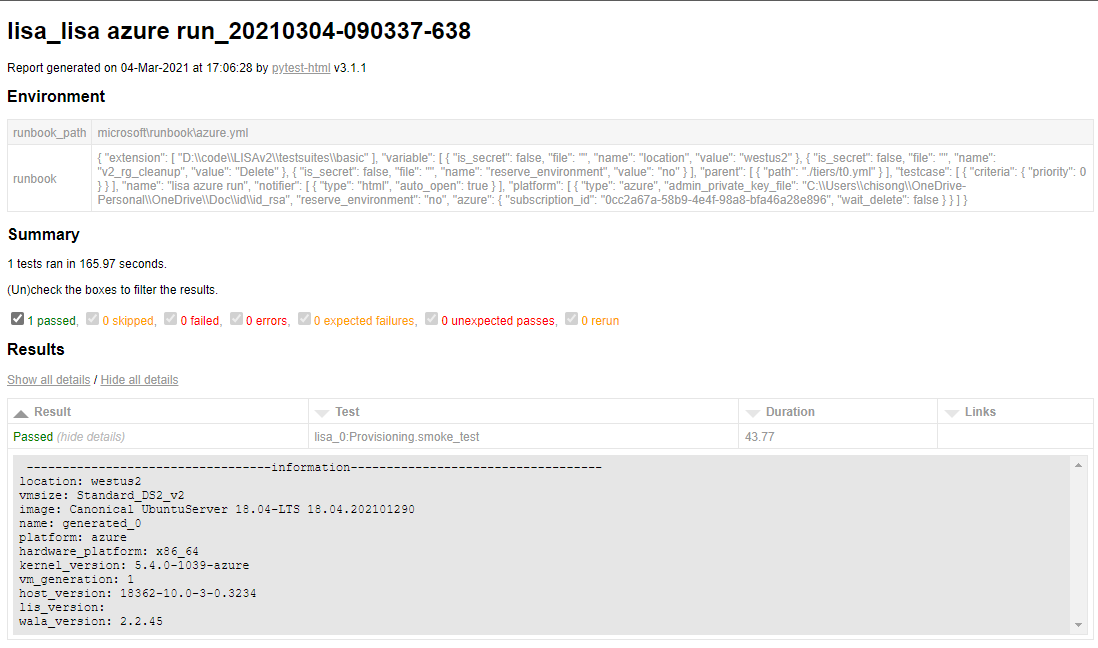
After the test is completed, you can check the LISA console log, or the html report file for the test results. Refer to Understand test results for more detailed explanation of the logs and report. See an example html report as below:
Test specific cases with debug runbook
LISA provides a debug runbook to run specific test cases by name. This is useful for debugging and testing individual cases.
Simple example with case and origin:
lisa -r microsoft/runbook/debug.yml \
  -v "case:hello" \
  -v "origin:azure.yml" \
  -v subscription_id:<subscription id>
Note
See Run LISA for more advanced usages.